The Oxford Handbook of Plato by Gail Fine
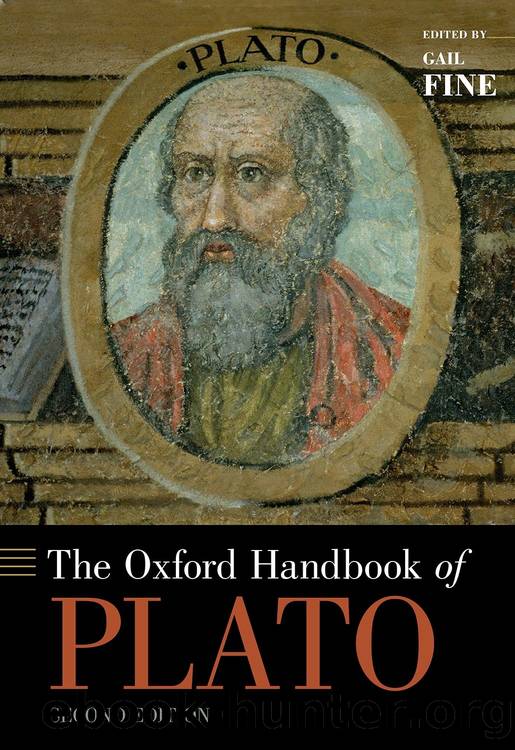
Author:Gail Fine [Fine, Gail]
Language: eng
Format: epub
ISBN: 9780190639754
Publisher: OxfordUP
Published: 2019-09-05T00:00:00+00:00
Chapter 16
The Epistemology and Metaphysics of Socrates
Gareth B. Matthews
The portrayal of Socrates in the early dialogues of Plato is the most vivid picture we have of any ancient philosopher. Prominent in that depiction is the story Socrates tells us in the Apology about his reaction to being told that, according to the oracle at Delphi, no one was wiser than he (21a). Socrates responded to this news, he says, by trying to find someone of whom he could say, âThis man is wiser than I, but you said I was [wiser]â (21d).1 At least part of his test for determining whether a given candidate was wiser than he was to determine if the candidate knew something ânoble and goodâ (kalon kagathon). Socrates himself claimed to know nothing of that sort (21d).
Another part of his test was to see whether candidates thought they knew things that, in fact, they did not know. At Apology 22câd, Socrates says of the craftspersons that they knew many noble things [or fine or beautiful things, polla kalla], and so were, in that respect, wiser than he. But in the end, he concluded that they were not really wiser because they mistakenly thought themselves to be wise in other things. âThis error of theirs,â he explains, âovershadowed the wisdom they hadâ (22dâe). His own wisdom, he had already said, lay in his not thinking he knew what he did not know (21d). Apparently, no one excelled him in that!
On the face of it, the project of determining whether someone knows something noble and good is, at least in part, an epistemological one. So is the project of determining whether one thinks one knows something one does not really know. Both projects presuppose an understanding of what is to count as knowledge.
Some commentators claim that Socrates, as he is portrayed in the early dialogues of Plato, has no epistemology at all, or at least no epistemological theory. Thus Gregory Vlastos, the dean of Socrates scholars in the twentieth century, writes: âIn fidelity to our texts no epistemological theory at all can be ascribed to Socrates.â2 Vlastos is equally dismissive of the suggestion that Socrates has a metaphysics. Socrates, he writes, âis as innocent of epistemology as of metaphysics.â It is part of my purpose in this chapter to show how it can be appropriate to speak of the epistemology and the metaphysics of Socrates, but another part is to make clear why someone might also have doubts or reservations about whether Socrates even has an epistemology or a metaphysics at all.
An even more fundamental issue dogs the project of this chapter: namely, the problem of how we can know anything about the philosophy of the historical Socrates. We can call this âthe problem of the historical Socrates.â As I have already said, Plato has certainly given us an extremely vivid picture of Socrates in the early dialogues.3 But one may well ask how we can know that the picture Plato has given us is historically accurate.
The answer is surely that we cannot know.
Download
This site does not store any files on its server. We only index and link to content provided by other sites. Please contact the content providers to delete copyright contents if any and email us, we'll remove relevant links or contents immediately.
The remains of the day by Kazuo Ishiguro(9006)
Tools of Titans by Timothy Ferriss(8403)
Giovanni's Room by James Baldwin(7354)
The Black Swan by Nassim Nicholas Taleb(7137)
Inner Engineering: A Yogi's Guide to Joy by Sadhguru(6800)
The Way of Zen by Alan W. Watts(6621)
The Power of Now: A Guide to Spiritual Enlightenment by Eckhart Tolle(5790)
Asking the Right Questions: A Guide to Critical Thinking by M. Neil Browne & Stuart M. Keeley(5779)
The Six Wives Of Henry VIII (WOMEN IN HISTORY) by Fraser Antonia(5519)
Astrophysics for People in a Hurry by Neil DeGrasse Tyson(5196)
Housekeeping by Marilynne Robinson(4455)
12 Rules for Life by Jordan B. Peterson(4312)
Ikigai by Héctor García & Francesc Miralles(4279)
Double Down (Diary of a Wimpy Kid Book 11) by Jeff Kinney(4278)
The Ethical Slut by Janet W. Hardy(4262)
Skin in the Game by Nassim Nicholas Taleb(4257)
The Art of Happiness by The Dalai Lama(4133)
Skin in the Game: Hidden Asymmetries in Daily Life by Nassim Nicholas Taleb(4012)
Walking by Henry David Thoreau(3969)
